
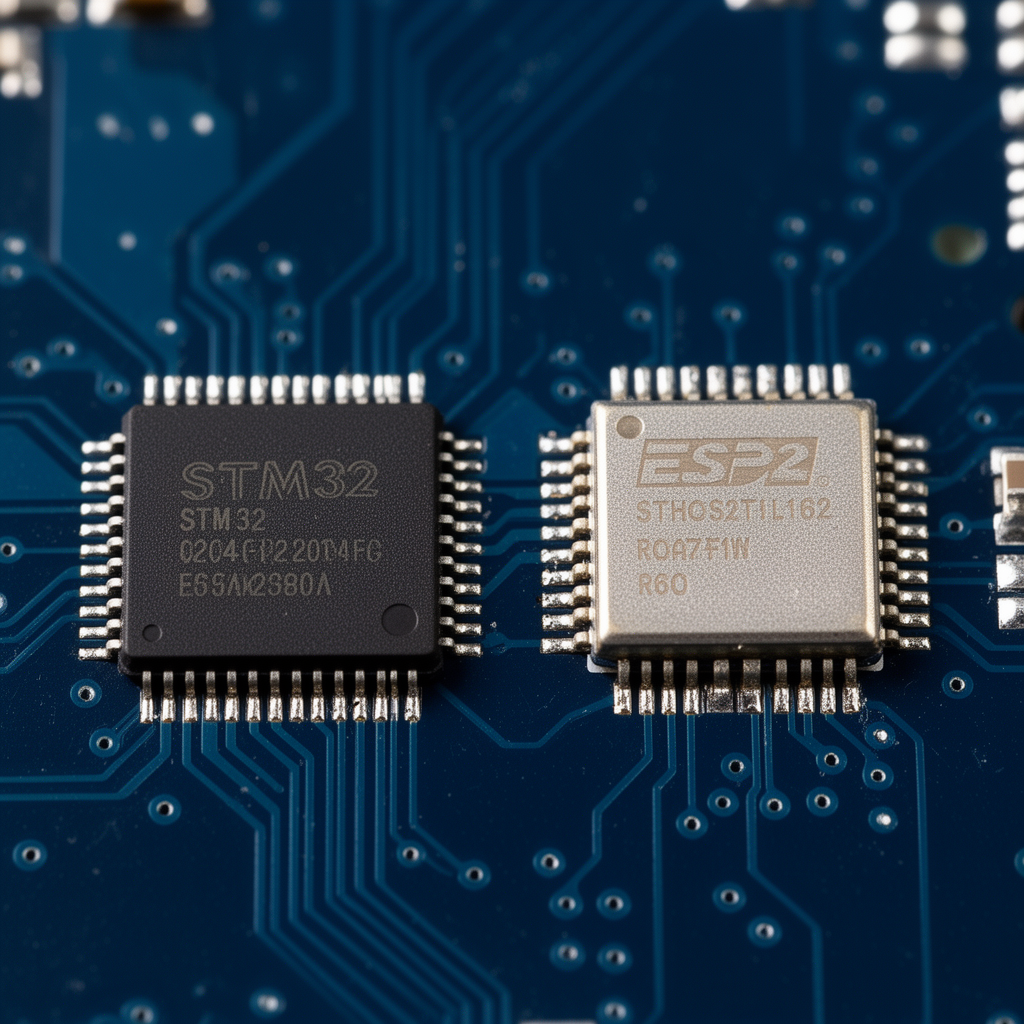
Selecting the central processor for a wireless sensor node often comes down to a balance between raw processing power and strict power budgets. The ESP32 offers built-in Wi-Fi and Bluetooth connectivity at a budget-friendly price point, while the STM32 family provides precision peripheral control and minimal baseline current draw. Understanding how their architectural differences handle active and sleep states is essential for building devices that last years on a single charge.
Power Consumption and Sleep State Dynamics
The ESP32 utilizes dual Tensilica LX6 cores that deliver high throughput for network stack handling, but its active current consumption often hovers between 80 to 240 milliamperes during radio transmission. In contrast, an ultra-low-power STM32 micro-controller operating at lower clock speeds typically draws less than a few milliamperes in active execution. When dropped into deep sleep, the STM32 can idle around sub-microamp levels, whereas standard ESP32 development boards often draw significantly more due to onboard peripheral circuitry.
Processing Overhead and Wireless Integration
Integrated Wi-Fi on the ESP32 eliminates the need for external transceiver chips, saving PCB trace real estate and reducing hardware assembly complexity. However, if your application only requires periodic low-bandwidth data transmission over SPI or I2C to an external radio module, the STM32 ARM Cortex-M architecture provides far superior interrupt latency and deterministic timing. For heavy sensor processing without continuous wireless links, the dedicated hardware peripherals on the STM32 deliver greater execution efficiency.
Selecting the Right Platform for Your Project
When building a device that requires frequent cloud communication and high data rates, the all-in-one ESP32 silicon platform remains the standard recommendation for quick hardware deployment. For remote environmental monitors where battery longevity, precise analog-to-digital conversions, and rapid wake-up cycles are critical, investing in an STM32 design yields significantly longer field lifespan and higher thermal resilience.